Switching sides: How three families found success with Droughtmasters
22 Oct 2025We’re all looking for the right fit. A breed that thrives in our country, meets market demand, and makes our business stronger for the next generation. Meet three producers who’ve found their match in Droughtmasters.
Derek and Lara Mays, Templin, Queensland
Ten years ago, Derek and Lara set out to start a stud as a legacy for their then infant son Thomas. There was just one question – Charolais or Droughtmasters?
He put in a call to both societies, but it was the friendly, warm welcome from Droughtmaster Australia that steered him down the Droughtmaster path.
A visit from the late Neil Donaldson, then CEO of Droughtmaster Australia, sealed the deal.
“Neil came and looked at our cattle and actually classified some cows for us,” Derek says.
“We had lunch, a chat, and he made a big impression on us. He was a great man, and I appreciated everything he did for us.”
The Droughtmaster community has given Derek more than just a breed; it’s given him mentors, friendships, and a sense of belonging. The late Bruce Wilson was among the most influential, visiting the property regularly to share honest critiques that Derek appreciated.
“I don’t want people to come here and tell me everything looks great,” Derek says. “I want them to tell me ways I could improve. You can always take something away, even if it’s just something small, and that can help in the long run.”
It’s been a successful journey for the family who run over 100 breeders and recently came close to topping the 2023 Droughtmaster National Female Sale.
“That’s something I never dreamed of, and I feel pretty proud that even as a smaller operation, we’re kicking goals,” Derek says.
With a fulltime job as an electrician, the breed’s low maintenance and tick resistance suits Derek. Running cattle in scrub country comes with its challenges, and in the early days as Derek’s off-farm work mounted, the difference became clear – after three weeks the other cattle would have plenty of ticks, while the Droughties were still clean.
“It was a no-brainer,” he says. “I was wasting so much time and money on chemicals on the other breeds, so we decided we’d just stick with the Droughties. And then we thought, if we can only run a smaller herd, they might as well be the best quality cows we can run.”
These days Thomas is right by Derek’s side when it comes to running the stud. When the school day ends,
Derek knows right where Thomas will be.
“He’s got his own buggy and dog now and they just set off down the paddock to tend to the herd. He just loves it,” Derek says.
“We focus a lot on temperament because Thomas does all the work with me. They’ve got that naturally quiet, gentle temperament and it’s a pretty special thing.”

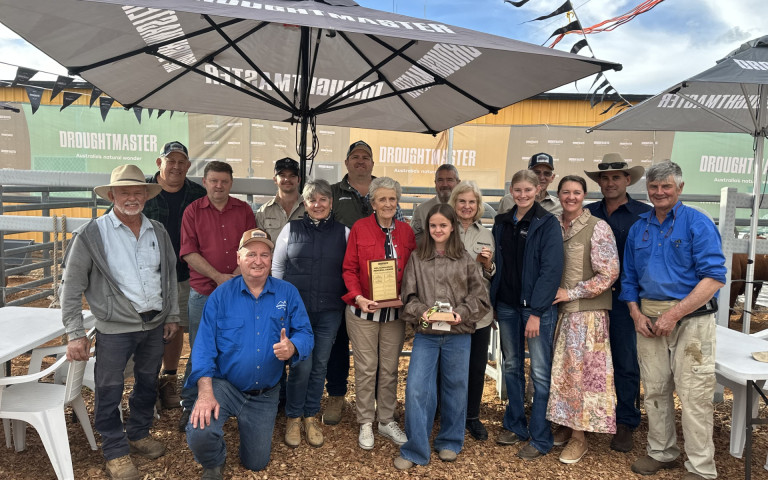
Thomas, Derek & Lara Mays, Templin, Queensland.
Jim and Margaret Harvey, Roadvale, Queensland
Twenty-four years ago, Jim Harvey began thinking about reshaping his Hereford stud. He turned to the late, legendary Wally King and declared he was “ready to go all red.” Wally’s advice? You need Droughtmasters.
Jim and wife Margaret are based at Roadvale, Queensland, run a commercial Droughtmaster herd of between 110 and 120 breeders and turn cattle off into the MSA grass-fed market.
Jim was drawn towards the breed in part for its clean coat and agility to handle the range country. But mostly, he had one tiny but mighty problem that needed solving.
“The tick part was what really stood out to me and within three years of having Droughties our tick problem disappeared,” Jim says.
“We put a Brahman bull in first and then put Droughtmasters. We tried a few different things – Gelbviehs and Santas – but we stuck with the Droughtmasters.”
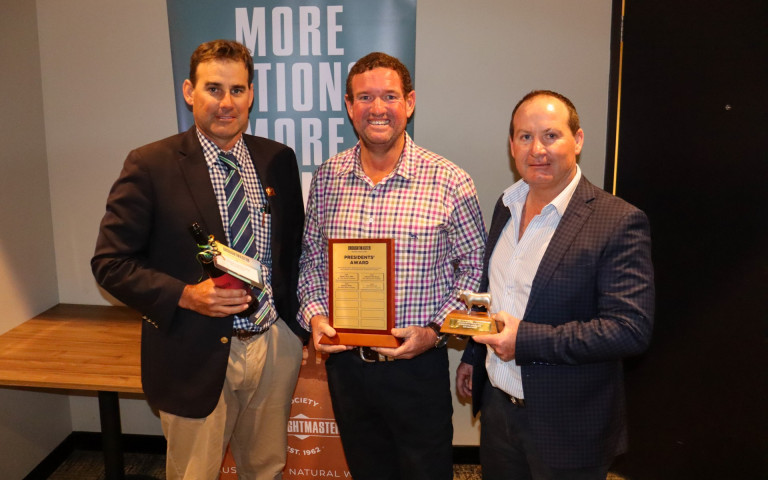
It’s been a successful pairing for the couple who recently won the 2025 RNA Paddock to Palate Class for the highest individual index score (60.06) in class 38c MSA Eating Quality competition. The win drew praise from Droughtmaster Australia members online, with one describing what they’ve done for the breed as “immeasurable and deserving of breed recognition for their loyalty and effort.
Jim and Margaret are no strangers to success in the ring. In 2022 they claimed Champion Carcase in the 70-day class of the prestigious Paddock to Palate awards, while also securing second place in the pen of six carcases in the same category. Their track record goes back further, with strong results in the Beaudesert carcase competitions. One year, the Harveys dominated by winning four out of five classes and taking out Reserve Champion. The following year, they went one better to claim Champion Carcase – all with Droughtmaster cattle.
Ever the realist, Jim has one piece of advice for others thinking about switching to the breed.
“It’s a myth that all Droughtmasters are good. There’s no such thing as perfect cattle but so long as you look at structure, EMAs, and buy from a reputable breeder, you should be on to a good thing.”
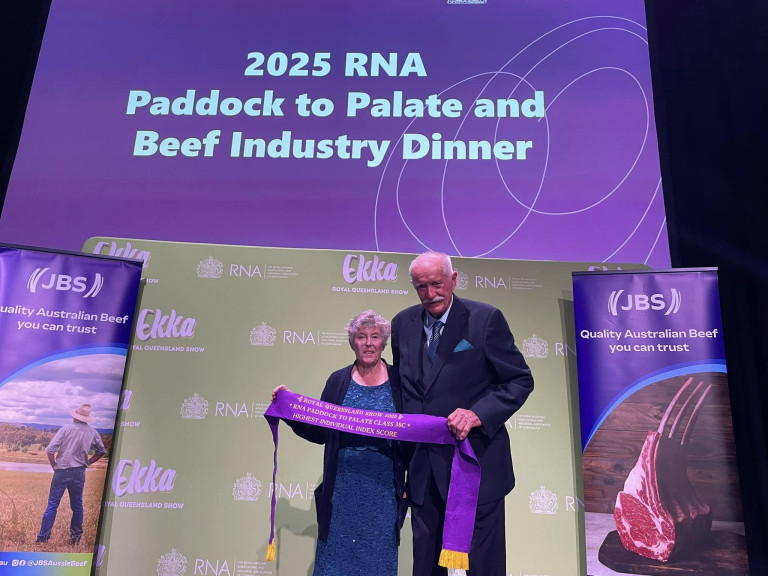
Margaret & Jim Harvey, Roadvale, Queensland.
Lynne and Phillip King, Bollon, Queensland
Livestock agents told Lynne and Phillip King to cross their Droughtmaster cows with a “softer breed” to produce offspring that would be more suitable to the weaner/feeder market – but they had other ideas.
“We actually felt quite insulted by that and decided to just keep doing what we were doing,” Lynne laughs.
It’s paid off for the couple who’ve been breeding Droughtmasters since 2010 at Bollon, Queensland on their properties ‘Runnymede’ and ‘Moorindoorah’.
The hooded eyes of Droughtmasters were a big drawcard, helping avoid the eye cancer common in Herefords, which were previously the breed of choice in the family operation.
Their temperament and adaptability to the couple’s semi-arid country ticked another two big boxes. Even in the depths of drought over the years, Lynne says the breed’s hardiness has always shone through and their mothering ability never waned. The ease of calving and low birth weights particularly attracted the couple to the Droughtmaster breed. Calving has been notably easy, with only three known cases of calves lost over the past 25 years.
But ultimately, it’s their temperament that earned their place at Runnymede and Moorindoorah.
“We’re still always blown away by their temperament,” Lynne says.
“It’s made the whole weaning process really easy, it makes our work easy, and it makes handling in the cattle yards a safe process.”
Lynne and Phillip’s focus is now on running a self-replacing breeder operation – and these days they’ve got plenty of agents on their side.
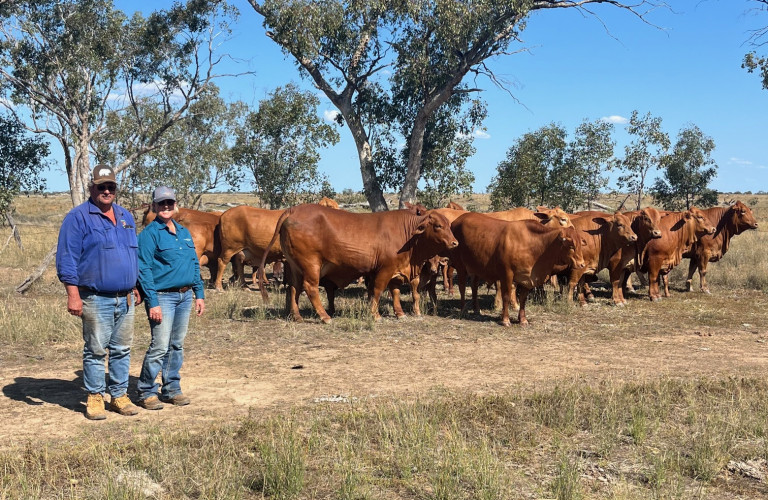
Phillip & Lynne King, Bollon, Queensland.